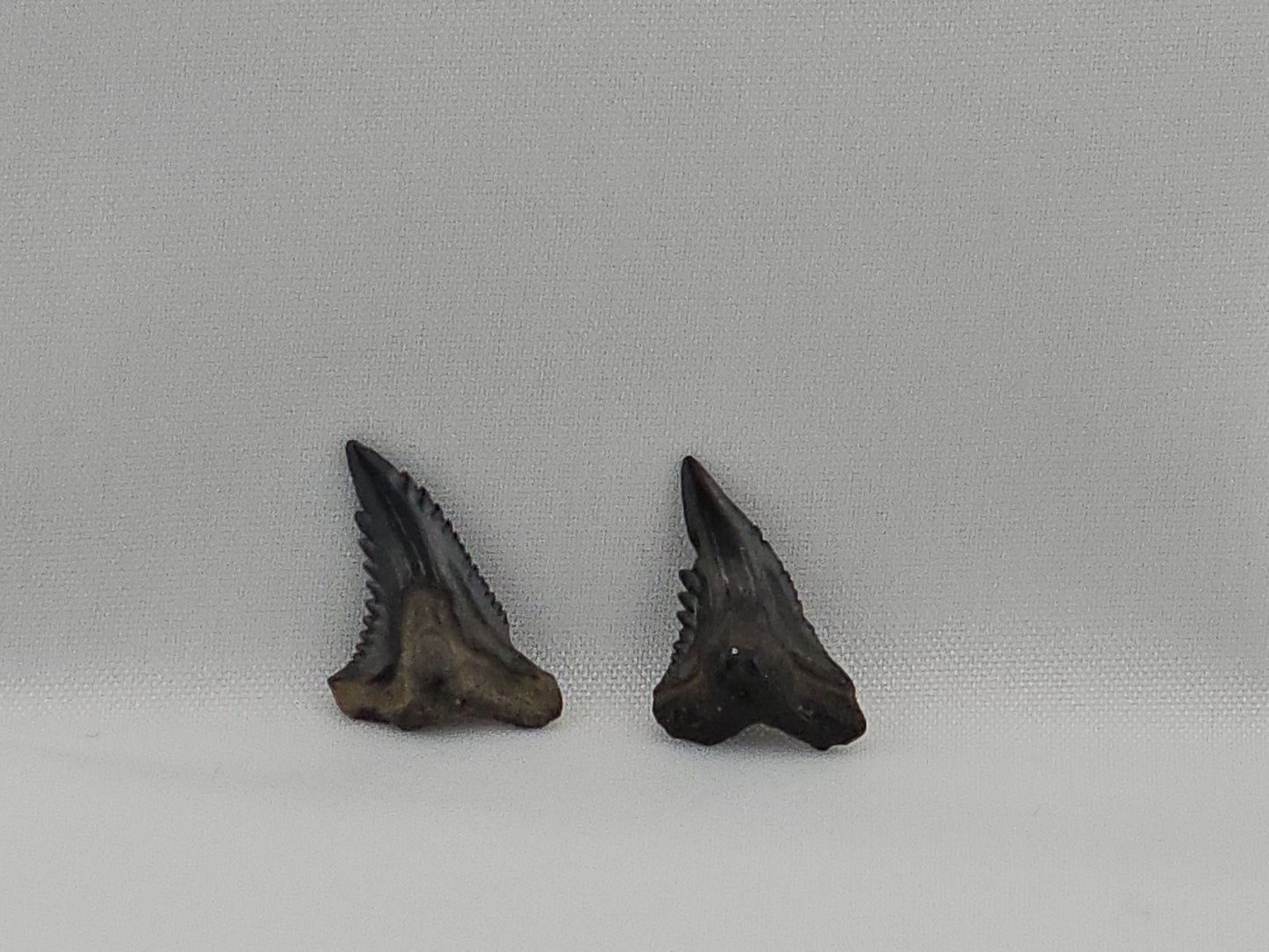
Set of 8 Snaggletooth Shark Teeth ID#60
Set of 8 Snaggletooth Shark Teeth ID#60
Couldn't load pickup availability
Common Name: Snaggletooth Shark
Scientific Name: Hemipristis serra
Epoch:Miocene, Pliocene
Fossil Type: Tooth
Fossil Size: 0.59, 0.59, 0.60, 0.61, 0.63, 0.65, 0.69, 0.70 Inches 1.50, 1.51, 1.52, 1.55, 1.60, 1.65, 1.76, 1.80 cm
Location Found: Florida
Info about Hemipristis
The Hemipristis genus dates back to the eocene with species such as H. curvatus. The genus has only one extant (living) member H. elongata which gets to approximately 240cm (7.87ft), and primarily consumes fish, crustaceans, & cephalopods. (This species has not caused any known shark attacks). Its extinct relative H. serra however, got to well over 20ft in size and dined on large aquatic mammals such as dugongs and dolphins.
References
Chaskar, K., Sagar, R., Padia, D. J., MS, A., Chauhan, G., K, P., … Thakkar, M. (2025). New record of selachian (shark) fauna from the early Miocene (Aquitanian) of Kachchh region (western India): palaeoecological and palaeobiogeographic significance. Historical Biology, 1–25. https://doi.org/10.1080/08912963.2025.2540449
Hemipristis Serra. Panama Canal Project (PCP PIRE). (n.d.). https://www.floridamuseum.ufl.edu/panama-pire/fossils/gatun/hemipristis-serra/Jambura, P. L., Pfaff, C., Underwood, C. J., Ward, D. J., & Kriwet, J. (n.d.). Tooth mineralization and histology patterns in extinct and extant snaggletooth sharks, Hemipristis (carcharhiniformes, hemigaleidae)-evolutionary significance or ecological adaptation?. PLOS ONE. https://journals.plos.org/plosone/article?id=10.1371%2Fjournal.pone.0200951
Snaggletooth Shark - Sharkwater extinction. (n.d.). https://www.sharkwater.com/shark-database/sharks/snaggletooth-shark/
Species implicated in attacks. International Shark Attack File. (n.d.). https://www.floridamuseum.ufl.edu/shark-attacks/factors/species-implicated/
Share