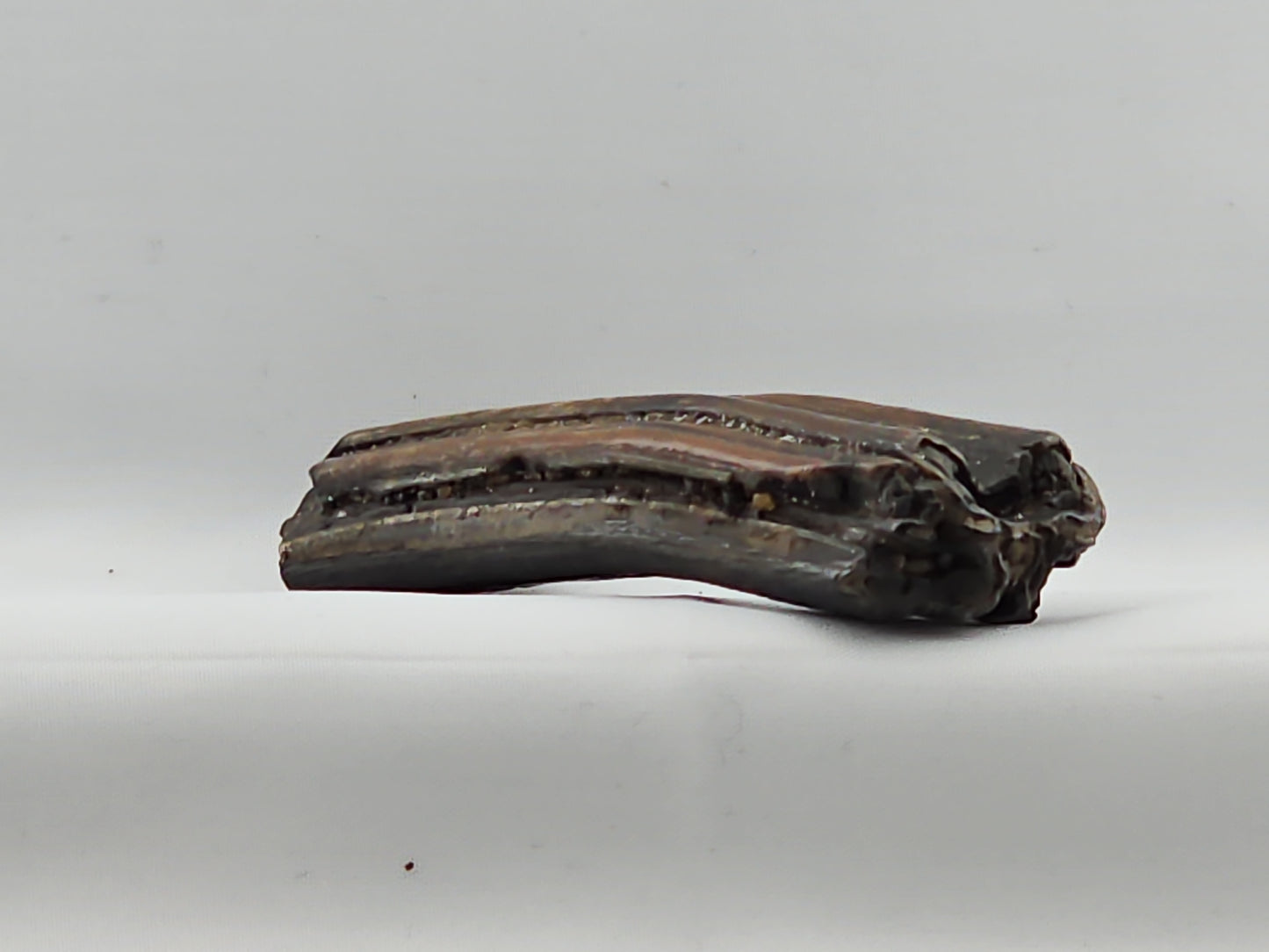
Horse Tooth ID#69
Horse Tooth ID#69
Couldn't load pickup availability
Common Name: Horse
Scientific Name: Equus sp.
Epoch:Pleistocene
Fossil Type: Tooth
Fossil Size: 2.93 Inches 7.44 cm
Location Found: Florida
Info about the Family Equidae
Only one genus from the family Equidae still lives today the genus: Equus. This genus encompasses all modern “horse” species including the three species of zebra, both the wild and domestic horse species, the three donkey species, and many other extinct species of Equid. However, there used to be many more genera through pre-history. From the genus Hyracotherium (of the most primitive (known) horses dating back to the Eocene, it had so many differing features from modern horses a 19th century scientist misidentified as a monkey), to Archaeohippus (a cat sized horse with toes not hooves), to Megahippus (a giant horse for the Miocene epoch (but still small by today's standards at 585lbs) the Equid morphology has greatly differed through pre-history. Despite diverse morphology one thing remains consistent across all Equid lineages: they are all herbivores, though what vegetation they specialized in consuming differed by the environmental niche that species filled.
Reference:
Archaeohippus. Fossil Horses. (n.d.). https://www.floridamuseum.ufl.edu/fossil-horses/gallery/archaeohippus/
Carr, D. S. M. (n.d.). Equid tooth evolution. https://www.mun.ca/biology/scarr/Equid_tooth_evolution.html#:~:text=Molariform%20teeth%20of%20Hyracotherium%20are,there%20is%20a%20cementum%20layer.
Dinohippus. Fossil Horses. (n.d.-b). https://www.floridamuseum.ufl.edu/fossil-horses/gallery/dinohippus/
Equus. Fossil Horses. (n.d.-c). https://www.floridamuseum.ufl.edu/fossil-horses/gallery/equus/
Hypohippus. Fossil Horses. (n.d.-d). https://www.floridamuseum.ufl.edu/fossil-horses/gallery/hypohippus/
Hyracotherium. Fossil Horses. (n.d.-e). https://www.floridamuseum.ufl.edu/fossil-horses/gallery/hyracotherium/
Kalobatippus. Fossil Horses. (n.d.-f). https://www.floridamuseum.ufl.edu/fossil-horses/gallery/kalobatippus/
Megahippus. Fossil Horses. (n.d.-g). https://www.floridamuseum.ufl.edu/fossil-horses/gallery/megahippus/
Merychippus. Fossil Horses. (n.d.-h). https://www.floridamuseum.ufl.edu/fossil-horses/gallery/merychippus/
Miohippus. Fossil Horses. (n.d.-j). https://www.floridamuseum.ufl.edu/fossil-horses/gallery/miohippus/
Mesohippus. Fossil Horses. (n.d.-i). https://www.floridamuseum.ufl.edu/fossil-horses/gallery/mesohippus/
Neohipparion. Fossil Horses. (n.d.-k). https://www.floridamuseum.ufl.edu/fossil-horses/gallery/neohipparion/
Orohippus. Fossil Horses. (n.d.-l). https://www.floridamuseum.ufl.edu/fossil-horses/gallery/orohippus/
Parahippus. Fossil Horses. (n.d.-m). https://www.floridamuseum.ufl.edu/fossil-horses/gallery/parahippus/
Pliohippus. Fossil Horses. (n.d.-n). https://www.floridamuseum.ufl.edu/fossil-horses/gallery/pliohippus/
Share